In a previous post, I referred to an incident that occurred during the 1996 air and artillery assault on southern Lebanon which the Israelis called Operation Grapes of Wrath. The artillery barrage on a UN refugee camp in Qana in 1996 killed 100 civilians, and resulted in international condemnation of the Israeli operartion, and led to a US-brokered cease fire (which took nearly 3 further weeks to achieve). In that blog entry, posted 13 days ago, I wrote:
But with each passing day, the potential for a Qana-like event grows stronger. There are two trend lines in play here which have not yet intersected: one trend line is the effective degradation of Hizbollah C3 (command, control & communications) capabilities; the other trend line is domestic and US governmental sympathy for the operation. The calculated bet in applying air power against Lebanon and its infrastructure is that the trend line for support of the operation may deteriorate before the strategic goal is realized. And then instead of "new rules," Olmert & Co. will be faced with a slightly degraded Hizbollah, another meaningless cease fire agreement, and no change in the regional equation.
And today, on the 19th day of the war, and in precisely the same place, an Israeli air attack struck a site in Qana at 1 am local time in which 28 people were killed (16 of whom were children - as often happens, original reports on these numbers were inflated by a factor of two). While the exact details of the attack are unclear (a Lebanese Red Cross worker reports that the site was attacked twice, once at 1 am, once at 7 am -- while the Israeli Air commander reports a single attack, and then a 7 hour delay before reports of the deaths became public), the results are disastrous for the Israeli leadership. As the day progressed, over 150 Hizbollah rockets fell on northern Israel, a new single-day record (over 70 fell on the abandoned town of Kiryat Shemona). The world media has been broadcasting images from Qana all day long, and it now looks like the two trend lines I referred to have crossed. What may have been a long-term "window of opportunity" for the IDF in Lebanon has now been shortened.
Word of the bombing in Qana came to the Israeli government as it was in session in the company of Condoleezza Rice. Earlier in the day the Israelis were absolutely convinced that the American "green light" was still in effect; at the cabinet meeting Condi was reported to be stunned, and the Israeli Defense Minister found himself explaining the incident to a shocked guest -- we warned the residents to leave, Hizbollah hides amongst civilians, rockets were fired within 30 yards of the struck building, and the launch crew ran into the building. Possibly unsaid in the meeting is that the American forces in Iraq have done things just as horrific. But it is clear that such claims will fall on deaf ears.
With the door now closing on open American support for the Israeli operation, and the IDF in a state of multi-divisional mobilization, a decision will soon be made whether to continue the current operation at its present pace, or to use the approximately 14 days which remain to expand the ground campaign. The public stance of the Israeli government is still projecting determination to achieve a military win on the battlefield. But all spin aside, this operation has got to be judged a failure so far. While certainly the operation has weakened Hizbollah -- rather than breaking Hizbollah, Hizbollah emerges in the Arab world the heroic victor. Hizbollah claims for itself the bragging rights for driving the Israelis out of Lebanon in 2000; now it can claim it withstood the Israeli army and stood its ground for 3 weeks. Now Olmert & Co. are subject to debilitating internal second-guessing, and it is quite likely their careers (or at least their legacies) are in jeopardy. In my judgment, Olmert, Peretz and Halutz have stumbled from one bad decision to the next throughout this campaign -- now comes the toughest decision of all. Based on their past performance under pressure, expect them to make another ruinous choice.
Sunday, July 30, 2006


Friday, July 28, 2006
"Bogged Down"
In the annals of the Arab-Israeli conflict, two battles are remembered well by both sides, though neither was particularly decisive for the military equation. One battle occurred in March 1968 in Karameh, Jordan; the other took place in 1982 at Beaufort Castle in southern Lebanon. In 1968 Israel launched a reprisal raid against a Fatah stronghold in the Karameh camp after an Israeli bus had been blown up, killing a doctor and nurse. Fatah forces were tipped off to the reprisal and put up a defense which took a high toll from the Israeli forces. In levelling the town and killing 120 Fatah fighters, the Israelis lost 28 men. But the memory within the Palestinian community was of valiant resistance against the "great" Israeli military machine, and forever since Karameh has become taken on mythic status within Palestinian circles. Indeed, the Palestinian narrative of this battle is credited with the growth in popularity of Fatah and Yasser Arafat in the 1970s.
When the IDF invaded Lebanon in June 1982 it encountered a number of difficult battles, including the so-called "Masada" of the Palestinian movement, the battle of Ein al-Hilwe. But it was early on, at Beaufort Castle (a crusdaer ruin on the border with Israel), which first gave Israelis pause in their ultimately successful dash for Beirut. The PFLP fighters defended the observation post at Beaufort to the last man, and the elements of the Golani brigade which attacked it suffered 25% casualties. The IDF and PM Menahem Begin were shocked by the effort encountered at Beaufort. Beaufort Castle became another mythic symbol to Palestinians and the Arab world that the IDF can be met with strong confrontation.
Bint Jubayl will likely go down in the annals of Hizbollah narrative as their own mythic struggle. While one Israeli minister is reported to have preferred levelling the town with air attacks, the IDF is struggling to gain the upper ground with casualties that are generating criticism in the Israeli media. Having rhetorically prepared the Israeli hinterland for a grandiose war which will "change the rules" of the Hizbollah-Israel equation, the Israeli press is now reporting that its generals are "surprised" and confounded by the defenders of this Hizbollah stronghold. One Pentagon source was quoted today as describing the IDF as "bogged down" in Bint Jubayl. It has been said that in 1982, Israel found its Vietnam. In 2006, the makings for another slog through the hills of southern Lebanon seems quite the possibility. Neiher Ehud Olmert nor Amir Peretz could survive another Vietnam-like experience in Lebanon. And having launched this war of choice, engaging Syria now militarily would likely constitute political suicide, even if the outcome preserved Israeli control over the Golan Heights. With Condoleezza Rice returning to the area this evening, armed now with a Joint British-American call for a cease fire, it looks like only the most minimal of the IDF strategic goals -- "the diminishing of the Hizbollah threat" -- is in hand. No 12-mile buffer; no 1-mile buffer; no dead Hizbollah leadership; no breaking of Hizbollah command and control. If the fighting ends soon, the Israeli warriors and their newly tested civilian leaders will be judged rather harshly as having failed to effect a decisive military result in anticipation of a political arrangement.
As Tom Friedman pointed out earlier this week, Israel will have to diplomatically reengage Syria if it hopes to achieve protection from the Hizbollah missile threat, exactly as the IDF war gamers in 2004 envisioned. The battle of Bint Jubayl, carried out by Israel and Syrian surrogates, may very well become the battle which led to Israeli withdrawal from the Golan Heights.
Neither side has bet "all in" just yet. But the stakes are being raised, and no one is bluffing.
When the IDF invaded Lebanon in June 1982 it encountered a number of difficult battles, including the so-called "Masada" of the Palestinian movement, the battle of Ein al-Hilwe. But it was early on, at Beaufort Castle (a crusdaer ruin on the border with Israel), which first gave Israelis pause in their ultimately successful dash for Beirut. The PFLP fighters defended the observation post at Beaufort to the last man, and the elements of the Golani brigade which attacked it suffered 25% casualties. The IDF and PM Menahem Begin were shocked by the effort encountered at Beaufort. Beaufort Castle became another mythic symbol to Palestinians and the Arab world that the IDF can be met with strong confrontation.
Bint Jubayl will likely go down in the annals of Hizbollah narrative as their own mythic struggle. While one Israeli minister is reported to have preferred levelling the town with air attacks, the IDF is struggling to gain the upper ground with casualties that are generating criticism in the Israeli media. Having rhetorically prepared the Israeli hinterland for a grandiose war which will "change the rules" of the Hizbollah-Israel equation, the Israeli press is now reporting that its generals are "surprised" and confounded by the defenders of this Hizbollah stronghold. One Pentagon source was quoted today as describing the IDF as "bogged down" in Bint Jubayl. It has been said that in 1982, Israel found its Vietnam. In 2006, the makings for another slog through the hills of southern Lebanon seems quite the possibility. Neiher Ehud Olmert nor Amir Peretz could survive another Vietnam-like experience in Lebanon. And having launched this war of choice, engaging Syria now militarily would likely constitute political suicide, even if the outcome preserved Israeli control over the Golan Heights. With Condoleezza Rice returning to the area this evening, armed now with a Joint British-American call for a cease fire, it looks like only the most minimal of the IDF strategic goals -- "the diminishing of the Hizbollah threat" -- is in hand. No 12-mile buffer; no 1-mile buffer; no dead Hizbollah leadership; no breaking of Hizbollah command and control. If the fighting ends soon, the Israeli warriors and their newly tested civilian leaders will be judged rather harshly as having failed to effect a decisive military result in anticipation of a political arrangement.
As Tom Friedman pointed out earlier this week, Israel will have to diplomatically reengage Syria if it hopes to achieve protection from the Hizbollah missile threat, exactly as the IDF war gamers in 2004 envisioned. The battle of Bint Jubayl, carried out by Israel and Syrian surrogates, may very well become the battle which led to Israeli withdrawal from the Golan Heights.
Neither side has bet "all in" just yet. But the stakes are being raised, and no one is bluffing.
Tuesday, July 25, 2006
Is Bint Jubayl the Only Battle?
Condoleezza Rice has come and gone, due back in the region later this week. In the meantime, the warfare on the northern front continues primarily as an air campaign, but with a visible ground element in a single concentrated area.
If published reports are to be believed, it has taken the IDF a week to overrun Marun ar-Ras and surround the Hizbollah fighters of Bint Jubayl and its satellite villages, a single penetration of about 2.5 miles into Hizbollah territory inside Lebanon. It has been for the Israeli army a (purposely?/frustratingly?) slow and costly battle, and sometimes the fighting was hand-to-hand. If Bint Jubayl was one of the primary launching grounds of Hizbollah, it is certainly not the only one, as today's salvo of over 90 Katyushas prove. One sometimes reliable, sometimes crazy, web site claims that there are 11 other Bint Jubayl-level centers of Hizbollah concentration along the Lebanon-Israeli border, though I assume that a good number of these run along the border with the disputed Golan Heights. It is hard to imagine that this single kill zone between Avivim and Bint Jubayl will be the only battleground.
The IDF is not engaging in a mad dash to the Litani River. Instead it is working on a single Hizbollah pocket, probably because it has not been instructed to re-create a sterile buffer zone, but possibly because it wants to learn and study from this battle as to what exactly Hizbollah forces are capable of. Will the battle of Bint Jubayl be recorded as the first of many such ground actions, or will it be the single battle of the ground war in 2006? It is hard for me to imagine that the IDF (and the tough-talking Israeli government) will be satisfied for all its effort with this single hard-won victory. Thus, as the battle of Bint Jubayl ends, expect the ground war to widen.
If published reports are to be believed, it has taken the IDF a week to overrun Marun ar-Ras and surround the Hizbollah fighters of Bint Jubayl and its satellite villages, a single penetration of about 2.5 miles into Hizbollah territory inside Lebanon. It has been for the Israeli army a (purposely?/frustratingly?) slow and costly battle, and sometimes the fighting was hand-to-hand. If Bint Jubayl was one of the primary launching grounds of Hizbollah, it is certainly not the only one, as today's salvo of over 90 Katyushas prove. One sometimes reliable, sometimes crazy, web site claims that there are 11 other Bint Jubayl-level centers of Hizbollah concentration along the Lebanon-Israeli border, though I assume that a good number of these run along the border with the disputed Golan Heights. It is hard to imagine that this single kill zone between Avivim and Bint Jubayl will be the only battleground.
The IDF is not engaging in a mad dash to the Litani River. Instead it is working on a single Hizbollah pocket, probably because it has not been instructed to re-create a sterile buffer zone, but possibly because it wants to learn and study from this battle as to what exactly Hizbollah forces are capable of. Will the battle of Bint Jubayl be recorded as the first of many such ground actions, or will it be the single battle of the ground war in 2006? It is hard for me to imagine that the IDF (and the tough-talking Israeli government) will be satisfied for all its effort with this single hard-won victory. Thus, as the battle of Bint Jubayl ends, expect the ground war to widen.
Saturday, July 22, 2006
First Israeli Protest
Saturday night anywhere between 2,000-2,500 protesters against the wars on the Lebanese border and in Gaza gathered in Tel Aviv. For the first time in history, official Israeli Jewish and Israeli Arab political movements organized the event. This coalition of organizations included Meretz and Balad, Gush Shalom and Hadash, and there was an anti-American theme voiced along with calls for Olmert and Peretz to resign. One of the slogans used at the protest was: "We will not die and we will not kill for the USA" (trust me, it works as a chant in Hebrew).
There is of course an interesting parallel, to the 1982 protest movement which arose over Israel's major invasion of Lebanon, and changed the public perception of the war. While there are substantial differences between this confrontation with Hizbollah and the 1982 invasion (it would be better to compare it to Operation Accountability of 1993), this first public crack in the Israeli "consensus" may be significant. What is missing this time is the Labor party as an opposition party, as it was in 1982. This time Labor is up to its neck in Lebanon and cannot serve as the galvanizing force of a protest movment. It is clear for the moment that the majority of Israelis supported the air campaign which has been waged for the first 8 days of the northern war. But either the air campaign failed to achieve its objective (despite a drop of 23 tons of armament on Burj al-Barajneh - an Israeli version of the failed "head shot" of Shaykh Nasrallah on Wednesday); or the plan all along in "binder 2" was to continue on with a ground campaign. Now there are a new string of significant ground casualties, young men in their 20s. Is a domestic protest movement shaping up?
While Haaretz and Maariv both report that the protest was peopled by "Arabs and Jews" (note which group comes first in both formulations), right-wing Maariv goes one degree further in marginalizing the protest with the internet headline: "The Tel Aviv 'Bubble' is also against the war," a reference to the new Eitan Fox movie I reveiwed in a previous post. Maariv you might remember is the same paper that earlier this week that referred to Shaykh Nasrallah as "Satan." It is the Fox News of Israel.
(Technical note: I've added "word verfication" to the comment feature for this blog because the blog is being spammed with useless comments, which I have erased)
There is of course an interesting parallel, to the 1982 protest movement which arose over Israel's major invasion of Lebanon, and changed the public perception of the war. While there are substantial differences between this confrontation with Hizbollah and the 1982 invasion (it would be better to compare it to Operation Accountability of 1993), this first public crack in the Israeli "consensus" may be significant. What is missing this time is the Labor party as an opposition party, as it was in 1982. This time Labor is up to its neck in Lebanon and cannot serve as the galvanizing force of a protest movment. It is clear for the moment that the majority of Israelis supported the air campaign which has been waged for the first 8 days of the northern war. But either the air campaign failed to achieve its objective (despite a drop of 23 tons of armament on Burj al-Barajneh - an Israeli version of the failed "head shot" of Shaykh Nasrallah on Wednesday); or the plan all along in "binder 2" was to continue on with a ground campaign. Now there are a new string of significant ground casualties, young men in their 20s. Is a domestic protest movement shaping up?
While Haaretz and Maariv both report that the protest was peopled by "Arabs and Jews" (note which group comes first in both formulations), right-wing Maariv goes one degree further in marginalizing the protest with the internet headline: "The Tel Aviv 'Bubble' is also against the war," a reference to the new Eitan Fox movie I reveiwed in a previous post. Maariv you might remember is the same paper that earlier this week that referred to Shaykh Nasrallah as "Satan." It is the Fox News of Israel.
(Technical note: I've added "word verfication" to the comment feature for this blog because the blog is being spammed with useless comments, which I have erased)
Friday, July 21, 2006
Mobilization
As predicted, "you ain't seen nothin' yet." Reports come in today Friday of a far greater call-up of Israeli reservists. As best I can tell, until today there were 3 battalions, approximately 3,000, called up to duty. Israeli media sources are now reporting that 2 more divisions (that is at least 20,000 soldiers) are going to be added to the Galil Division in the north for the ground fight. In order to make it possible for more of the standing army to move to the north, at least a brigade's worth of soldiers were called up this morning. This translates into a potentially massive call-up, and now even the internet is being used to issue general instructions for Order 8 (Hebrew site of the IDF), as I explained in yesterday's post. Having squeezed out one more week of diminished economic output from the domestic workforce, this weekend's widespread call-up (the Israeli weekend is Friday/Saturday) marks the beginning of what the Israeli leadership hopes is the endgame. It will probably take 24 hours for reservists to marry up with their equipment. By Sunday the ground war will be in full gear.
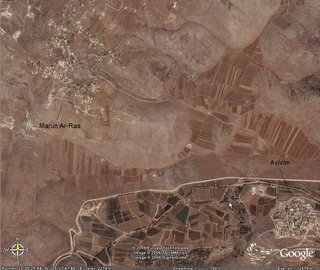 The ground battles are fierce, particularly around Avivim/Marun Ar-Ras (click on picture for more ground detail), with significant casualties on both sides. Hizbollah is a very formidable ground force, but this is no surprise. Of course, this begs a simple question: if the powerful IDF cannot easily subdue Hizbollah ground forces, what point is there to the stated strategy (and debatable tactics which are being employed) of pressing the Lebanese government and army into "controlling" Hizbollah? There seems to me to be a conceptual disconnect here. Israeli military censorship, and the inability of western journalists to venture into the battlefield from Lebanon, means that there is no clear picture of what is taking place in these ground battles.
Simultaneously, after a slight dimunition of rocket salvos yesterday, the tempo of firings has picked up Friday to at least 90 launches by late afternoon.
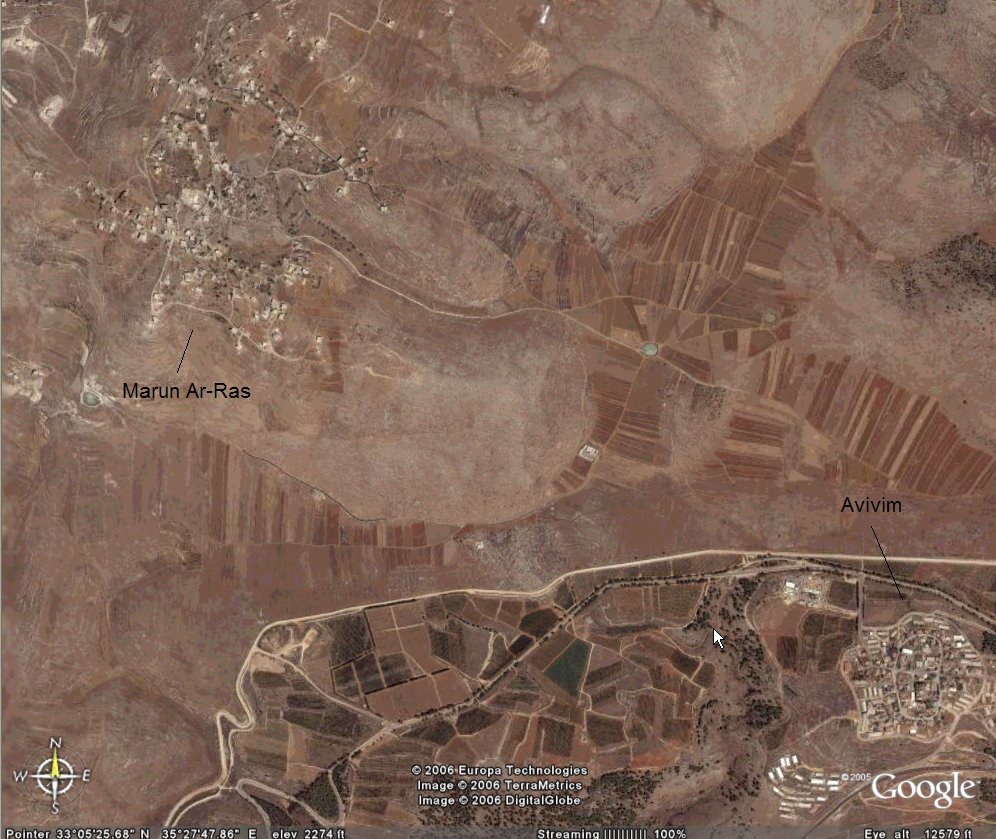 The ground battles are fierce, particularly around Avivim/Marun Ar-Ras (click on picture for more ground detail), with significant casualties on both sides. Hizbollah is a very formidable ground force, but this is no surprise. Of course, this begs a simple question: if the powerful IDF cannot easily subdue Hizbollah ground forces, what point is there to the stated strategy (and debatable tactics which are being employed) of pressing the Lebanese government and army into "controlling" Hizbollah? There seems to me to be a conceptual disconnect here. Israeli military censorship, and the inability of western journalists to venture into the battlefield from Lebanon, means that there is no clear picture of what is taking place in these ground battles.
Simultaneously, after a slight dimunition of rocket salvos yesterday, the tempo of firings has picked up Friday to at least 90 launches by late afternoon.
Subscribe to:
Posts (Atom)